7 Signs Your Home Spa Routine Has Too Many Steps
Quick Answer: A routine has too many steps when your skin is irritated, your products stop working, or you skip the whole thing because it takes too long. The most common cause is stacking multiple actives — retinoids, acids, vitamin C — that were each designed to be the star. Cutting back to a cleanser, one active, a moisturizer, and sunscreen resolves most of it within two weeks.
Somewhere between the eleventh product and the third serum, the routine stopped being a treat and started being a task.
And your skin, in most cases, stopped benefiting several steps before that.

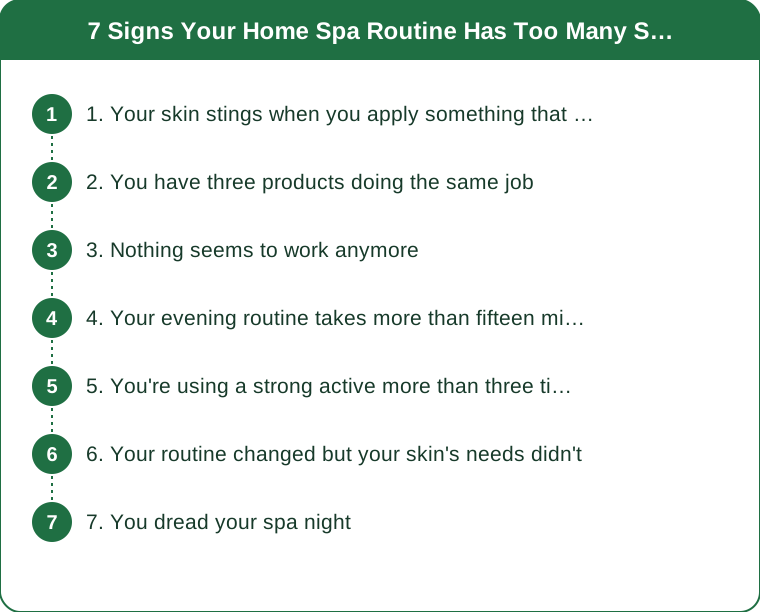
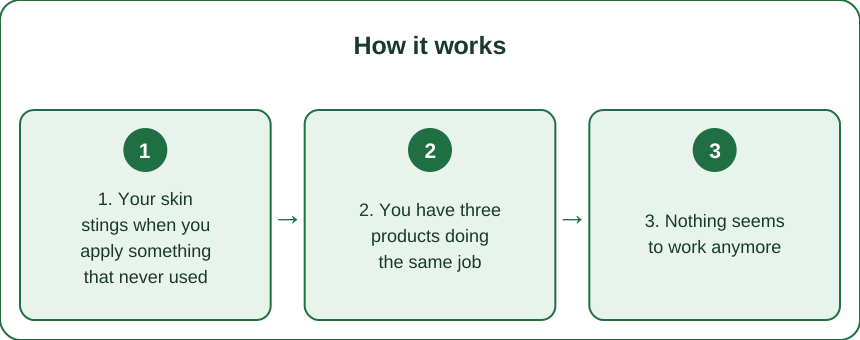
1. Your skin stings when you apply something that never used to sting
This is the clearest early signal of a compromised skin barrier, and it shows up before any visible redness does.
The barrier is the outer layer that holds moisture in and irritants out. Stack enough exfoliation, retinoids, and cleansing on top of each other and it thins. Once it does, products that were previously unremarkable start to sting — often a plain moisturizer or even water.
What to do: stop all actives for a week. Cleanser, moisturizer, sunscreen, nothing else. If the stinging resolves, you had too much, not the wrong products.
The instinct when skin gets irritated is to add a soothing product. That’s one more step on an already overloaded routine — removal works faster than addition.
2. You have three products doing the same job
Go read the ingredient lists on your shelf. Most people find two or three exfoliating acids, or two products with the same active at different concentrations, bought at different times for different reasons.
This happens naturally — you buy a toner for one thing, a serum for another, a cleanser recommended by someone else, and only later notice they all contain glycolic acid. Now you’re exfoliating three times per routine without ever deciding to.
What to do: group your products by function on the counter — cleanse, exfoliate, treat, hydrate, protect. Any group with more than one product is a decision you haven’t made yet. Keep the best one and shelve the others.
3. Nothing seems to work anymore
The usual interpretation is that skin adapted and the products stopped being effective. The more likely explanation is that with eight products on your face, you can’t tell what’s doing what.
With one active, a change in your skin is attributable. With five, any improvement or flare could be any of them, or the interaction, or the weather. You’ve lost the ability to learn anything from your own routine.
What to do: cut to the minimum, then add back one product at a time with two weeks between additions. It’s slow and it’s the only method that actually tells you which products earn their place. Most people finish this exercise using fewer products and getting better results.

4. Your evening routine takes more than fifteen minutes
Length is a practical problem before it’s a skin problem: routines that take too long get skipped, and skipped routines don’t work no matter how good the products are.
Consistency beats complexity by a wide margin. A four-step routine done nightly will outperform a ten-step routine done twice a week, and it isn’t close.
What to do: time your routine honestly for three nights. If it’s over fifteen minutes, cut until it’s under ten. The steps you resent are the ones to lose — your compliance rate matters more than any individual product’s marketing.
Layering wait times between products is often the real culprit. Most of those waits aren’t necessary for the products people apply them to.
5. You’re using a strong active more than three times a week
Retinoids and exfoliating acids work by accelerating cell turnover, and that process needs recovery time between applications. Nightly use of a strong active is appropriate for some people and far too much for most.
The signs of overuse are specific: flaking that doesn’t stop after the first few weeks, persistent redness, skin that feels tight, and — counterintuitively — increased breakouts as the barrier struggles.
What to do: drop to two or three nights a week and hold there for a month. Most people find results improve rather than decline, because the skin gets the recovery window the active depends on.
Myth vs Fact: Myth — if a little retinol works, more works faster. Fact — beyond a certain frequency, the added irritation slows visible progress. The limiting factor is how much your barrier tolerates, not how much active you apply.
6. Your routine changed but your skin’s needs didn’t
Routines tend to grow by accretion. A product gets added for a temporary problem — a breakout, a dry patch, a week of poor sleep — and then stays permanently after the problem resolves.
Six months later you’re running a routine designed for a version of your skin that no longer exists. This is especially common heading into fall, when people keep summer’s oil-control products while the air gets drier and skin needs the opposite.
What to do: twice a year, ask of each product: what is this for, and is that still true? Seasonal changeover is the natural prompt — late August into September is exactly the right moment to swap lighter summer formulas for something richer, and to drop anything you added during a heat wave.
7. You dread your spa night
This is the softest signal and possibly the most important one, because the entire premise of a home spa routine is that it should feel good.
If a fifteen-product Sunday routine has become an obligation you schedule and postpone, it has stopped delivering the thing you actually wanted. The relaxation was never a side effect — for most people it’s the main point, and the skin benefits are a bonus.
What to do: separate the two. Keep a short, functional daily routine that takes eight minutes and doesn’t require willpower. Then, when you actually want a spa night, do it as a genuine indulgence — a bath, a mask, unhurried, because you feel like it, not because it’s on the calendar.
Routines that need discipline are badly designed. The daily one should be short enough to be automatic; the occasional one should be enjoyable enough to want.
TL;DR:
- Stinging where there wasn’t stinging before is a barrier signal — remove products rather than adding a soothing one.
- Audit for duplicates: most shelves hold two or three products with the same active.
- If nothing seems to work, you probably can’t isolate what does. Cut back and reintroduce one product every two weeks.
- Strong actives two or three nights a week beats nightly for most people.
- A routine you dread has stopped doing its main job. Split the short daily one from the occasional real one.
Do the counter audit this week — group by function and see how many groups have more than one product. Most people cut three or four items in ten minutes and notice the difference in their skin before the month is out.
Keep Reading
This article is for general informational and styling purposes only. Fit, sizing, and product availability may vary.