7 Home Spa Steps That Work Better in a Cold Bathroom
Quick Answer: Cold bathrooms change product behaviour more than people expect. Thick balms and oils stop spreading, masks dry and tighten faster, and cold skin absorbs less. Warming the room and the product does more for results than upgrading either. Seven specific adjustments, ranked by how much difference they actually make.
This is general information, not medical advice.

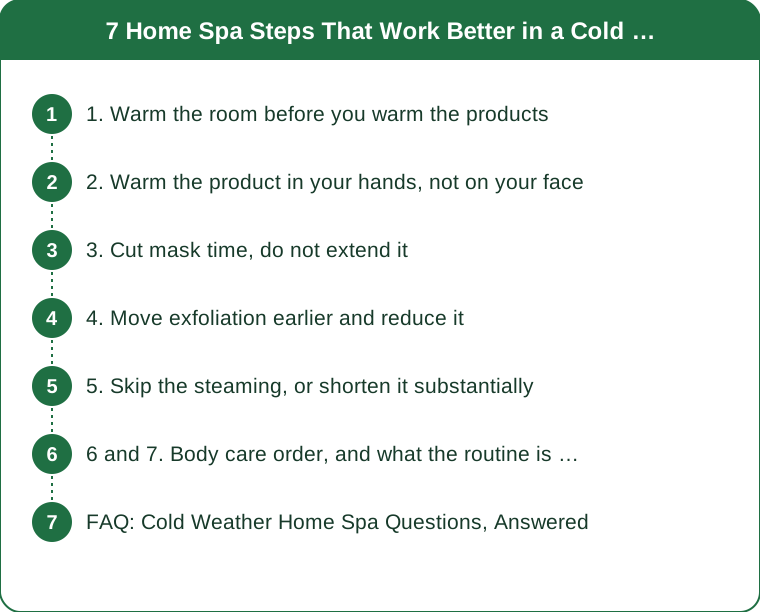
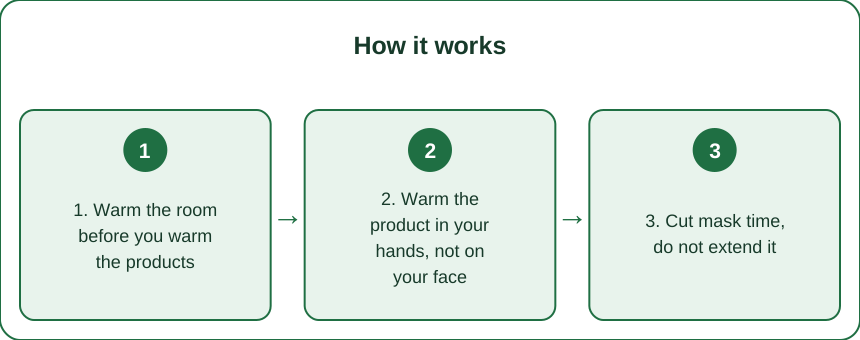
1. Warm the room before you warm the products
Cold skin has reduced surface blood flow, which affects both how products spread and how the skin feels afterwards. This is the reason a routine that felt luxurious in July feels perfunctory in November.
Fifteen minutes of heating beforehand is the whole intervention. A heated towel rail, a small fan heater, or simply running the shower for two minutes changes the entire experience.
It also affects whether you do it at all. Cold rooms shorten routines dramatically, and a shortened routine is the most common reason home spa nights stop happening in autumn.
The bathroom is often the coldest room in the house because it is the least occupied and frequently the least heated. Worth checking with a thermometer once rather than assuming.
Do this first and several of the following steps stop being problems.
2. Warm the product in your hands, not on your face
Balms, oils and thick creams thicken substantially as they cool and drag across the skin instead of spreading. Dragging is what causes the irritation people blame on the product.
Ten seconds between the palms is enough. It changes viscosity noticeably and improves spread across the whole face from a smaller amount.
This matters most for cleansing balms, which are formulated to melt at skin temperature and simply do not in a cold room.
Do not warm products in hot water or on a radiator. Some formulations separate, and actives degrade with heat.
Store products out of the bathroom in winter if it is unheated. Repeated temperature cycling is harder on formulations than a steady cool temperature.
3. Cut mask time, do not extend it
Cold air dries a mask faster, and a clay or sheet mask that has dried past its intended point starts pulling moisture back out of the skin rather than delivering it.
Ten minutes in a cold room may equal fifteen in a warm one. Check by touch rather than by the clock.
Never let a clay mask fully crack. That is past the useful point, and the tight feeling people associate with it working is actually dehydration.
Sheet masks are more forgiving but not immune. Remove while the sheet is still damp; the point at which it dries is the point at which the benefit reverses.
Apply a moisturiser immediately afterwards, within a minute, and more so in a cold room than a warm one.

4. Move exfoliation earlier and reduce it
Cold air and indoor heating both dehydrate skin, and dehydrated skin tolerates less exfoliation than it did in summer.
Cutting frequency is usually the correct autumn adjustment, from three times a week to once or twice for most people.
Physical scrubs are worse in cold weather because the barrier is already compromised. Chemical exfoliation at a lower frequency is generally gentler.
Do it earlier in the routine and follow with more occlusion than you would in summer.
Signs you have overdone it: stinging on application of anything, a tight feeling that does not resolve, and new sensitivity to products you have used for months. All three mean stopping for a week, not switching products.
5. Skip the steaming, or shorten it substantially
Facial steaming in a cold room produces a large temperature swing across the skin, which can trigger flushing and worsen redness in people prone to it.
Five minutes maximum, at a comfortable distance, and not at all if you have rosacea or persistent facial redness.
A warm damp cloth achieves most of the benefit with none of the thermal shock, and is the better cold-weather option.
Do not go straight from steam into a cold room. The rapid cooling is what causes the reaction, more than the heat itself.
Steam does not open pores. Pores do not have muscles. It softens the contents and hydrates the surface, which is useful and more modest than the marketing suggests.
6 and 7. Body care order, and what the routine is now for
6. Change the order of body care
Apply body products to damp skin, immediately after the shower,** and in a cold room this window is much shorter — perhaps 60 seconds rather than three minutes.
Have everything open and within reach before you get out. The single biggest reason body moisturiser gets skipped in winter is standing cold in a bathroom looking for a lid.
Oils applied over damp skin outperform creams applied to dry skin for sealing in moisture, and they spread better if warmed in the hands first.
Feet need more than they did in summer, as closed shoes and dry indoor air combine. A thicker balm plus socks overnight is the standard fix and it works.
Turn the water temperature down. Very hot showers strip the skin barrier, and the urge to have them rises exactly as the barrier is becoming more vulnerable.
7. Rethink what the routine is for
In summer, home spa routines are often about oil, sweat and sun. In autumn they shift toward barrier repair and dryness, which is a genuinely different set of products.
Simplify rather than add. More steps in a cold bathroom means a colder, longer, less pleasant routine, and it is the main reason people abandon the habit around this time of year.
Five well-chosen steps beat twelve. Cleanse, treat, moisturise, occlude where needed, and something for the body. That is enough for most people through winter.
Schedule it earlier in the evening. A routine at 9pm in a warm house happens; the same routine at 11pm in a cold bathroom does not.
Judge the routine on how your skin feels at 10am, not on how the evening felt. Barrier repair shows up the next morning.
If skin is persistently painful, cracked, bleeding, or not responding to gentler care over several weeks, see a professional rather than continuing to adjust products.
FAQ: Cold Weather Home Spa Questions, Answered
Should I switch all my products in autumn?
No. Change the moisturiser and reduce the exfoliation first, and only change more if those do not solve it. Wholesale switching makes it impossible to tell what worked.
Is a humidifier worth it?
In a home with central heating running most of the day, often yes. Indoor humidity drops substantially with heating, and that is a large part of winter skin dryness.
Does a hot bath damage skin?
Prolonged very hot water does strip the barrier. A warm bath of moderate length, followed immediately by moisturiser on damp skin, is fine for most people.
TL;DR:
- Heat the room for 15 minutes first; it fixes several of the other problems at once.
- Warm thick products in your hands — cold balms drag rather than spread.
- Shorten mask time rather than extending it, and never let clay fully crack.
- Cut exfoliation frequency and skip or shorten steaming.
- Apply body products within 60 seconds of getting out, with everything ready beforehand.
- Simplify to five steps; a long routine in a cold bathroom is a routine you stop doing.
The products did not stop working. The room changed.
This is general information, not medical advice.
Keep Reading
This article is for general informational and styling purposes only. Fit, sizing, and product availability may vary.