7 Reasons Your DIY Facial Never Quite Feels Like a Professional One
Quick Answer: The biggest gaps between a DIY facial and a professional one are usually not product quality but process — skipping proper double cleansing, rushing extraction/exfoliation steps that need more time, and skipping the facial massage technique that boosts circulation are the three most common reasons a DIY facial falls short.
The products at home are often genuinely comparable to what a spa uses. The technique and pacing are usually where the difference actually lives.
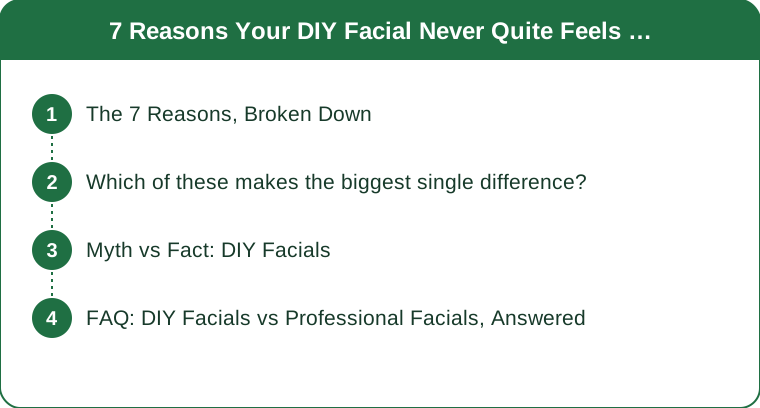
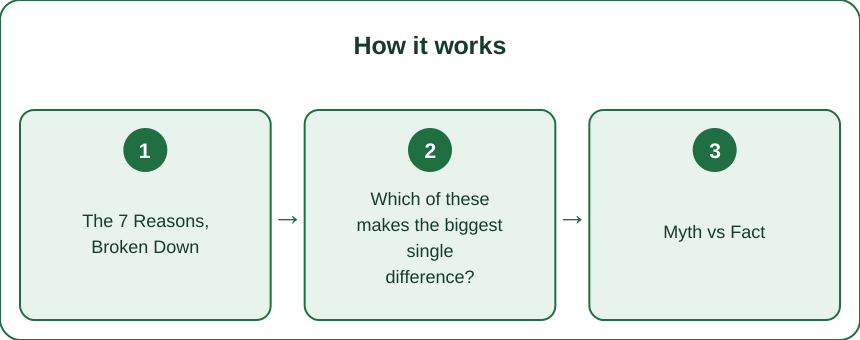
The 7 Reasons, Broken Down
1. Skipping double cleansing
A single cleanse often leaves residual makeup, sunscreen, and oil-based buildup that a professional’s oil-then-foam double cleanse removes more thoroughly, affecting how well every following step absorbs.
2. Rushing the steam step
Professional steaming typically runs 8-10 minutes, long enough to genuinely soften and open pores; a rushed 2-minute version at home doesn’t achieve the same effect, making the following exfoliation step less effective.
3. Skipping facial massage technique entirely
Professional facials include several minutes of specific massage technique that boosts circulation and product absorption — a step most DIY routines skip entirely because it’s not intuitive without training.
4. Over-exfoliating in an attempt to compensate
Without the steam and massage steps doing their part, there’s a tendency to over-exfoliate to compensate, which often leaves skin irritated rather than genuinely clean.
5. Using masks without matching them to actual skin need
Applying the same mask regardless of what skin needs that particular week (versus a professional’s on-the-spot assessment) means the treatment is often mismatched to what skin actually needs in the moment.
6. Skipping the environment entirely
Dim lighting, quiet, and an actual reclined position all measurably affect the relaxation-driven benefits of a facial — a facial done standing at a bathroom sink misses this component entirely.
7. Treating it as a single 10-minute step instead of a full sequence
A proper facial is a sequence of 5-7 distinct steps done in order and given adequate time each — combining or rushing steps is one of the most common ways the full effect gets lost.
Which of these makes the biggest single difference?
Steam time and facial massage together account for a large share of the “doesn’t feel the same” gap — both directly affect circulation and absorption in ways that products alone can’t replicate.
Myth vs Fact: DIY Facials
Myth: More expensive products close the gap with a professional facial. Fact: Technique and pacing matter more than product cost — a mid-range product used with proper steam time and massage often outperforms a premium product rushed through in 10 minutes.
Myth: A DIY facial should take about the same time as a shower. Fact: A full sequence with adequate time per step realistically takes 30-45 minutes, closer to a professional session’s actual length.
FAQ: DIY Facials vs Professional Facials, Answered
How often should a proper DIY facial sequence be done?
Once a week is a reasonable frequency for most skin types, allowing the skin to reset between sessions without over-treating.
Is facial massage technique hard to learn at home?
Basic upward, circular motion patterns are learnable from a short tutorial and provide meaningful benefit even without professional-level training.
Does water temperature during steaming matter?
Yes — water that’s too hot can irritate skin rather than help it; warm (not scalding) steam held at a safe distance is more effective and safer.
TL;DR:
- Technique and pacing usually explain the gap more than product quality does
- Double cleansing and adequate steam time (8-10 minutes) meaningfully affect every later step
- Facial massage technique is the most commonly skipped step, and one of the most impactful
- A proper facial sequence realistically takes 30-45 minutes, not 10
The products at home were probably never the problem — the missing minutes and missing steps were.
Keep Reading
This article is for general informational and styling purposes only. Fit, sizing, and product availability may vary.