7 Reasons Your At-Home Spa Night Never Feels Relaxing
Quick Answer: At-home spa nights usually fall short because of rushed pacing, an unclear phone-free boundary, and a space that still looks like everyday life — the fixes are mostly about environment and timing, not buying more products.
Same mask, same candle, same playlist as the actual spa uses. So why does it still feel like a chore squeezed between other tasks instead of something relaxing?
Reason 1: You’re Rushing Through It
Real spa treatments are paced deliberately — a facial alone often takes 45-60 minutes at an actual spa, while most at-home versions get compressed into 15-20 minutes squeezed between other tasks.
Blocking out a genuinely uninterrupted hour, treated the same way you’d protect an appointment time, changes the experience more than any product upgrade would.
Reason 2: Your Phone Is Still Within Reach
A phone nearby, even on silent, keeps a low level of alertness active that prevents the fuller relaxation response spas are designed to trigger through a phone-free environment.
Physically leaving your phone in another room for the duration, not just silencing it, removes the temptation to check it mid-routine.
Reason 3: The Space Still Looks Like Everyday Life
Doing your routine in a bathroom with laundry visible or dishes in the sink nearby keeps your brain in task-mode, since visual clutter is a subtle but real signal of unfinished obligations.
A five-minute reset — clearing counters, dimming harsh overhead lighting — before starting does more for the atmosphere than any candle scent choice.
Reason 4: You’re Multitasking Through It
Answering messages or watching TV during a mask splits attention in a way that prevents the mental downshift that’s a large part of what makes spa treatments feel relaxing in the first place.
Even simple single-tasking — just sitting with the mask on rather than doing something else simultaneously — meaningfully changes how relaxing the experience feels.
Reason 5: The Products Aren’t Suited to Your Skin
A mismatched product (too drying, too stimulating) can create mild discomfort that undercuts relaxation, regardless of how nice the packaging or scent is.
Choosing products based on your actual skin type and current needs, rather than whatever’s trending, avoids the low-grade irritation that quietly ruins the experience.
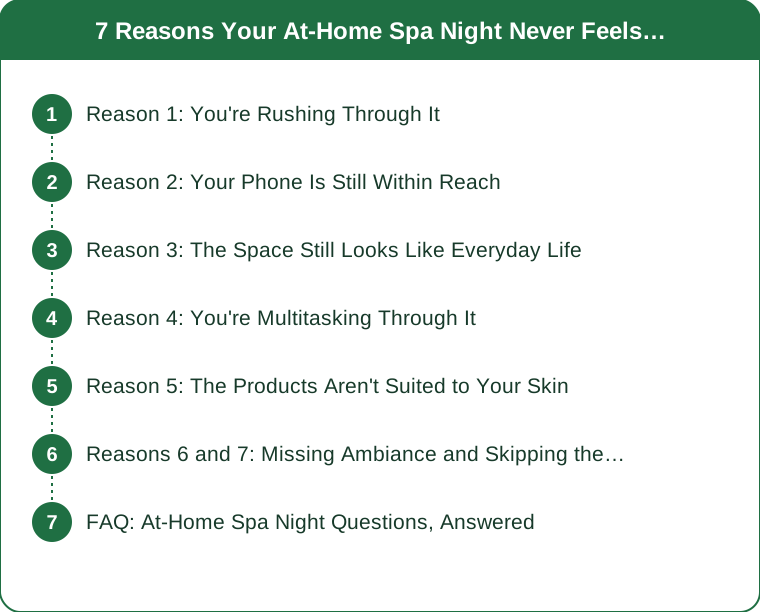
Reasons 6 and 7: Missing Ambiance and Skipping the Wind-Down After
Reason 6: No Real Ambiance Beyond a Candle
A single candle isn’t enough to fully shift the environment — temperature, lighting, and sound together create the atmosphere, and skipping any one of them (a too-bright bathroom, silence with no calming sound) leaves the experience feeling incomplete.
Reason 7: Jumping Straight Back Into Tasks After
Ending a spa routine and immediately returning to chores or screens erases much of the relaxation benefit, since the nervous system needs a few minutes to stay in that calmer state rather than snapping back to alert mode.
FAQ: At-Home Spa Night Questions, Answered
How long should a proper at-home spa routine actually take?
Aiming for 45-60 minutes total, matching real spa treatment pacing, gives enough time for products to work and for the mental shift to actually happen.
Does the order of steps matter?
Yes — cleansing, then a warm step (steam or a warm cloth) to open pores, then treatment products, then a cooldown step works with your skin rather than against it, and also naturally paces the experience.
Is background music or silence better for relaxation?
Either can work, but calming instrumental sound tends to outperform silence for most people, since true silence can sometimes highlight racing thoughts rather than quieting them.
TL;DR:
- Rushed pacing and phone proximity are the two biggest relaxation killers in DIY spa nights
- A cluttered space keeps your brain in task-mode even during a facial
- Products mismatched to your skin type create low-grade discomfort that undercuts relaxation
- Give yourself a few minutes to wind down after, instead of jumping straight back into tasks
Next spa night, put your phone in another room before you start — it’s the single easiest fix on this list.
Keep Reading
This article is for general informational and styling purposes only. Fit, sizing, and product availability may vary.