7 Home Spa Swaps for Skin at the End of Summer
Quick Answer: After a summer of sun, chlorine, sweat, and heavy cleansing, skin is usually dehydrated with a compromised barrier — not oily, even when it looks oily. Swap foaming cleansers for cream, cut acids in half, add a barrier-repair step, and delay any resurfacing treatments until the barrier is calm. The classic autumn mistake is starting an aggressive exfoliation routine on skin that’s already inflamed, which produces the sensitivity people then blame on the weather.
Your skin looks dull, feels tight, and is somehow breaking out and flaking at the same time.
That combination is barrier dysfunction, not two separate problems — and every product that promises to fix one half of it makes the other half worse.

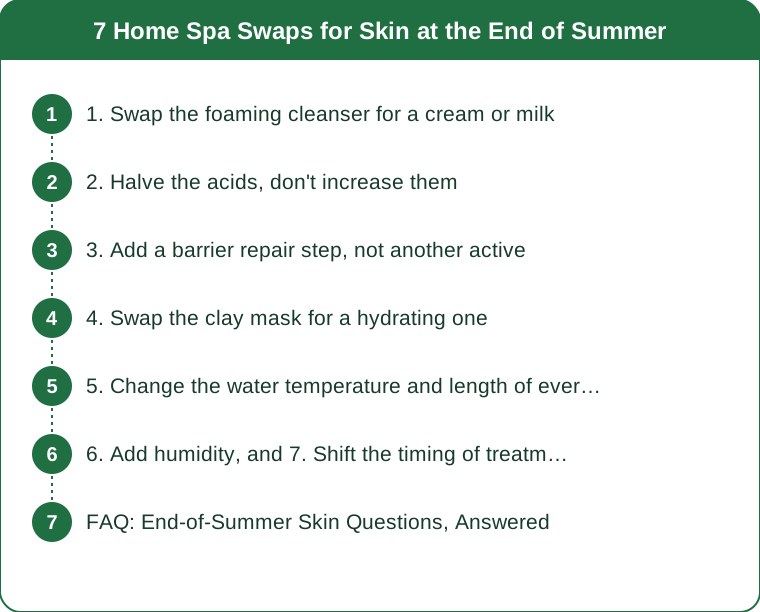
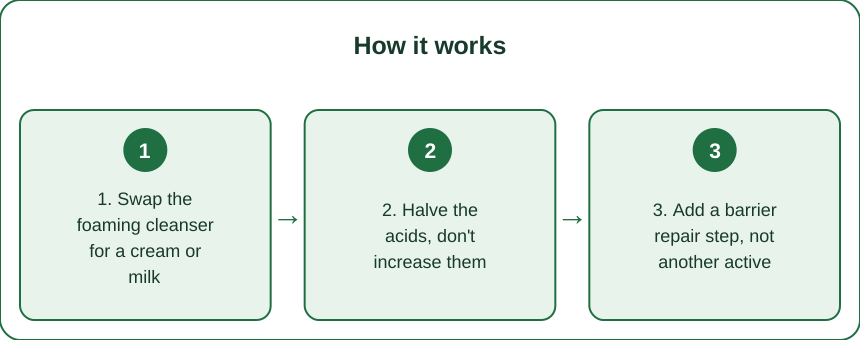
1. Swap the foaming cleanser for a cream or milk
Foaming surfactants strip an already-compromised barrier, and after a summer of double-cleansing sunscreen off daily, yours is compromised.
The tell is the tight feeling after washing. That sensation isn’t cleanliness — it’s the sound of your skin’s lipid layer being removed, and the oil surge two hours later is the rebound.
Cream, milk, and balm cleansers clean adequately without that strip. They feel less satisfying, which is precisely why people resist the swap. Effectiveness and squeakiness are not the same thing.
Keep one gentle foaming or gel cleanser for the evening if you wear sunscreen and makeup daily, and use the cream in the morning. Morning skin doesn’t need surfactants at all — it’s been on a clean pillowcase for eight hours.
Lukewarm water, always. Hot water on autumn skin removes lipids faster than any cleanser does, and it’s the free change that most improves how skin feels.
Give the swap two weeks. Skin coming off a stripping routine often looks worse for the first week as oil production normalizes, and that week is when people abandon the change.
2. Halve the acids, don’t increase them
The autumn instinct is to exfoliate away summer damage. It’s exactly wrong for the first few weeks.
Sun-exposed skin has elevated inflammation and reduced barrier function for weeks after the exposure ends. Adding acids to that state produces the stinging, redness, and sudden sensitivity that people interpret as a bad reaction to a product.
Cut frequency by half for two to three weeks. If you were using an AHA three times a week, go to once. Then rebuild.
Switch to gentler acids in the transition. Lactic acid and PHAs are considerably less irritating than glycolic and do useful work on dullness without the barrier cost.
Never combine acids with retinoids in the same fortnight if the skin is already reactive. Pick one, stabilize, then reintroduce the other.
The signs you’ve overdone it: stinging on application of products that used to be fine, sudden shininess without oil, small rough bumps, and redness around the nose and cheeks. All four resolve within two weeks of stopping — and only by stopping.
3. Add a barrier repair step, not another active
The single highest-value addition for autumn skin is boring: ceramides, cholesterol, and fatty acids.
These are the lipids your barrier is actually made of, and summer depleted them. A ceramide-containing moisturizer is a replacement, not a treatment, which is why it works quietly rather than dramatically.
Look for ceramides, cholesterol, and fatty acids together. The ratio matters more than any single ingredient, and formulations designed around barrier repair reflect that.
Squalane and niacinamide are the two best supporting ingredients. Squalane is exceptionally well tolerated and mimics skin’s own lipids. Niacinamide at 4 to 5% supports barrier function and reduces redness, with far fewer people reacting than at 10%.
Apply to slightly damp skin. Occlusive and emollient ingredients work by holding water in, and applying to bone-dry skin gives them less to hold.
Give it three to four weeks. Barrier repair happens at the pace of skin cell turnover, and there’s no shortcut. The improvement is real and it’s gradual.
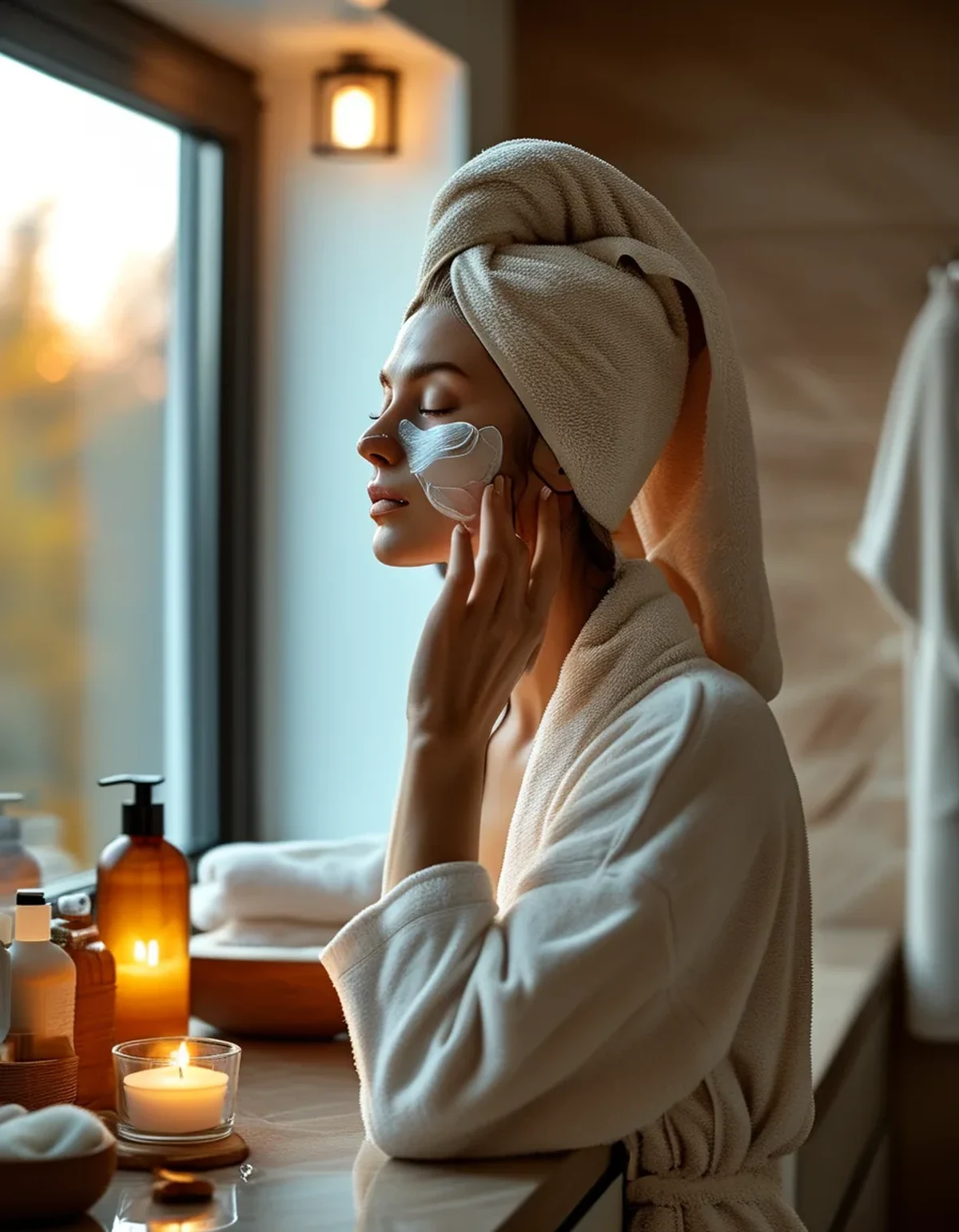
4. Swap the clay mask for a hydrating one
Clay masks made sense in humid July. In September they’re usually removing what’s already scarce.
Clay absorbs oil and water indiscriminately. On genuinely oily summer skin that’s useful. On autumn skin that looks oily because it’s dehydrated, it accelerates the problem — less water, more compensatory oil, tighter feeling, and a cycle that repeats.
Hydrating and barrier masks do more now. Look for hyaluronic acid, glycerin, panthenol, and ceramides rather than kaolin and bentonite.
Sheet masks are genuinely useful here because the occlusion holds humectants against the skin for 15 to 20 minutes. Remove them at 20 minutes — a drying sheet mask starts pulling moisture back out.
Keep one clay mask for spot use. Congested areas around the nose and chin still benefit, and a targeted application beats a full-face one.
Twice a week is enough. Masking more often than that is where people over-treat and then wonder why their skin got worse during a period of increased care.
5. Change the water temperature and length of everything
The bath and shower routine that was restorative in summer becomes a barrier problem in autumn, and the fix is free.
Hot water removes skin lipids directly. A long hot shower does measurable barrier damage — which is why skin feels tightest immediately after the most relaxing shower.
Lukewarm, and shorter. Ten minutes rather than twenty, and cooler than feels ideal on a chilly morning.
Baths are fine if you add something. A colloidal oatmeal or bath oil changes the equation substantially, because it leaves a light lipid layer behind rather than only removing.
Moisturize within three minutes of getting out. This window is real — the skin is at its most permeable and holds the most water immediately after bathing, and product applied then works significantly better than the same product applied twenty minutes later.
Body skin needs this more than face skin does and gets it far less. The first flaking of autumn is almost always shins, forearms, and upper back, all of which respond within days to a post-shower application that takes ninety seconds.
6. Add humidity, and 7. Shift the timing of treatments
6. Start managing indoor humidity now
Indoor heating drops relative humidity dramatically, and skin loses water directly to dry air.
Below about 40% relative humidity, transepidermal water loss increases measurably. Heated indoor air in autumn and winter routinely sits at 20 to 30%.
A humidifier in the bedroom is the highest-value one, because eight hours of overnight exposure is the longest continuous block. Target 45 to 50% — higher risks condensation and mold.
Clean it weekly, without exception. A dirty humidifier disperses what’s growing in it, which is worse than the dry air you were solving for.
A cheap hygrometer tells you whether it’s working, and most people are surprised at how dry their bedroom is.
7. Move treatments to the evening and space them out
Anything that increases photosensitivity belongs at night, and that includes acids, retinoids, and some botanical extracts.
Autumn sun is still meaningful. Lower angle, weaker UVB, and essentially unchanged UVA — which is the wavelength most relevant to photoaging and to sensitized skin.
Space actives across the week rather than layering them. Acids Monday and Thursday, retinoid Tuesday and Friday, nothing but barrier support in between. Layering multiple actives in one evening is the most common cause of self-inflicted sensitivity.
Sunscreen continues year-round. The autumn drop-off in sunscreen use is nearly universal and is the single largest gap in most routines — particularly for anyone using acids or retinoids, which make the skin measurably more vulnerable.
FAQ: End-of-Summer Skin Questions, Answered
How do I tell dehydrated skin from dry skin?
Dry skin lacks oil and feels rough and flaky consistently. Dehydrated skin lacks water and can be oily, tight, and flaky simultaneously — it often looks shiny while feeling tight, and fine lines appear more prominent. Dehydration is a temporary state; dryness is a skin type.
How long before my skin recovers from summer?
Barrier repair with consistent gentle care typically takes three to four weeks to feel normal. Pigmentation from sun exposure takes considerably longer — three to six months with treatment and sunscreen.
Should I start retinol now that summer is over?
Autumn is a reasonable time to start, but not on a compromised barrier. Spend two to three weeks on gentle cleansing and barrier repair first, then introduce retinoid twice a week and build slowly. Starting on stressed skin is why most people conclude they can’t tolerate retinoids.
Is a professional facial worth it in early autumn?
It can be, particularly a hydrating or barrier-focused one. Avoid aggressive peels and resurfacing until the barrier has recovered — a good esthetician will tell you the same and may decline to peel sun-stressed skin.
My skin got worse when I started being gentler. What’s happening?
Common and usually temporary. Skin that’s been over-cleansed produces compensatory oil, and it takes one to two weeks to normalize after you stop stripping it. Give the gentler routine three weeks before judging it.
This is general information, not medical advice. Persistent irritation or new skin changes are worth a dermatologist’s opinion.
TL;DR: Autumn skin needs less treatment and more repair — the opposite of the seasonal instinct.
- Swap foaming cleansers for cream or milk. The tight feeling after washing is barrier loss, not cleanliness.
- Halve your acid frequency for two to three weeks, and switch to lactic acid or PHAs during the transition.
- Add ceramides, cholesterol, and fatty acids — the boring step that does the most.
- Trade clay masks for hydrating ones. Skin that looks oily in autumn is usually dehydrated.
- Lukewarm and ten minutes, then moisturize within three minutes of getting out.
- Humidifier in the bedroom at 45 to 50%, cleaned weekly.
- Keep wearing sunscreen. The autumn drop-off is the biggest gap in most routines.
Start with the cleanser swap tonight. It’s the single change that makes every other product in your routine work better.
Keep Reading
This article is for general informational and styling purposes only. Fit, sizing, and product availability may vary.