7 Home Spa Steps People Do in the Wrong Order
Quick Answer: The sequence that works is: remove makeup, cleanse, steam or warm the skin, exfoliate, treat with a mask, tone and apply thin-to-thick actives, then moisturize and seal. The three most common ordering errors are exfoliating before cleansing, applying a mask over unprepped skin, and doing hair treatments last when they should be first. Order changes results more than product choice does.
Seven steps, and most people have at least two of them in the wrong place.

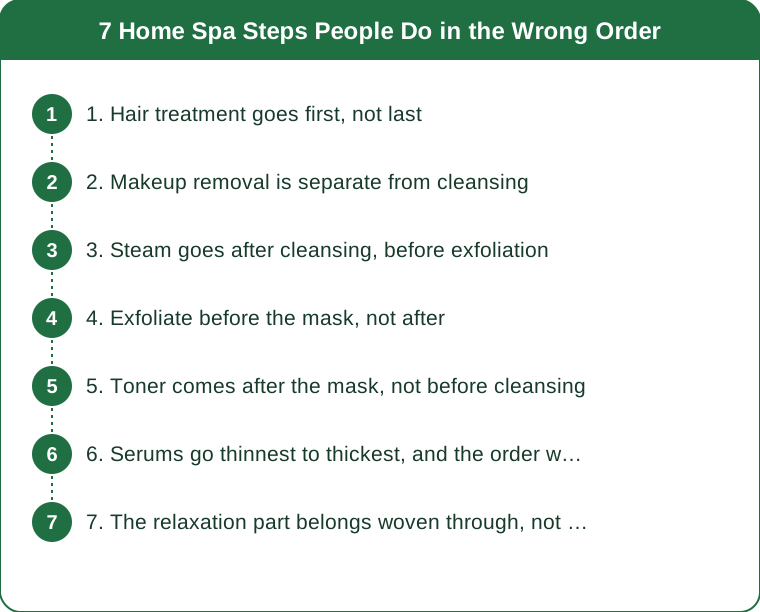
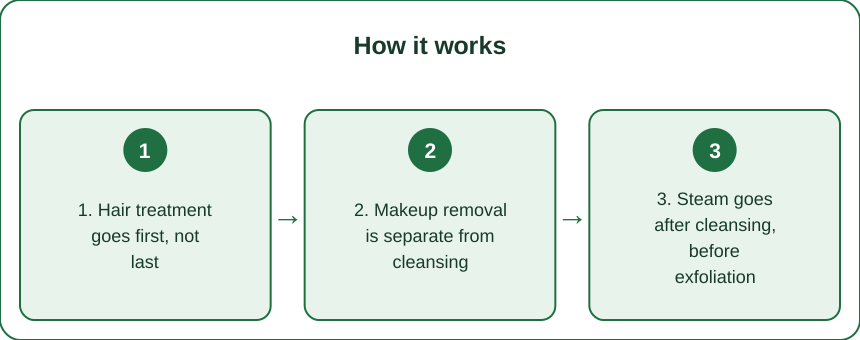
1. Hair treatment goes first, not last
Almost everyone saves the hair mask for the end and then rinses it out in the shower, which undoes the face routine they just completed.
Why first is correct: hair masks and oils benefit from long dwell time, and applying them at the start means they process for the entire duration of everything else. You are getting 40 minutes of treatment instead of 10 for zero additional effort.
How to do it: apply the mask to damp hair, clip it up, and wrap it in a towel or a shower cap. Warmth helps penetration, so a warm towel is a genuine upgrade rather than a spa affectation.
Then rinse it in the shower before you begin the face routine. This is the ordering fix — the shower happens in the middle of the evening, not at the end.
The exception: leave-in treatments and overnight oils obviously stay until the end. It is the rinse-out products that belong at the start.
2. Makeup removal is separate from cleansing
One cleanse does not do both jobs, and treating it as one step is why so many DIY facials underperform.
Why two steps: makeup, sunscreen and sebum are oil-soluble, and water-based cleansers do not dissolve them efficiently. A water-based cleanser used alone on a full face of makeup mostly redistributes it.
The sequence: an oil cleanser, balm or micellar water first to dissolve, then a gentle water-based cleanser to remove the residue and actually clean the skin. This is the double cleanse, and it is genuinely the step that makes the biggest visible difference for most people.
Do it on dry skin for the first cleanse. Oil cleansers emulsify with water at the end, not at the start, and applying them to a wet face dilutes them before they can work.
Time it properly: 60 seconds of actual massage for the first cleanse. Most people spend about 15 seconds, and that is not long enough to break down sunscreen.
3. Steam goes after cleansing, before exfoliation
Steaming dirty skin drives nothing anywhere useful, and steaming after exfoliation is unnecessary irritation on a freshly opened surface.
What steam actually does: it hydrates the outermost layer and softens both sebum and the dead-cell layer, which makes the next step more effective and less abrasive. It does not open pores, because pores do not have muscles, but the softening effect is real.
How to do it safely: a bowl of hot but not boiling water, face held about 12 inches above it, towel over the head, for 5 to 10 minutes maximum. Closer or longer risks burns and, for anyone prone to it, worsened redness or broken capillaries.
A gentler alternative that works nearly as well: a warm damp washcloth held against the face for two to three minutes, re-warmed once. Less dramatic, essentially no burn risk, and considerably easier to actually do.
Skip steam entirely if you have rosacea, active eczema, or skin that flushes easily and stays flushed. Heat is a well-known trigger, and the small benefit is not worth it.

4. Exfoliate before the mask, not after
This is the most common ordering error after the hair one, and it wastes the mask.
Why the order matters: a mask’s active ingredients have to get through the dead-cell layer to do anything. Applying a mask over unexfoliated skin means a substantial portion of the product is working on cells that are about to fall off anyway.
The correct sequence: cleanse, steam, exfoliate, rinse, then mask.
Choose one exfoliant, not two. Using a physical scrub and a chemical acid in the same session is the single fastest way to produce a compromised barrier, and it is remarkably common in DIY routines because both feel like they are working.
Frequency, not intensity, is what to control. Once or twice a week for most skin, and once every week or two for sensitive skin. If your skin feels tight, looks shiny in a plastic way, or stings with your normal moisturizer, you are over-exfoliating and the answer is to stop entirely for two weeks, not to switch products.
5. Toner comes after the mask, not before cleansing
Toner has moved around a lot in skincare routines over the years, and the confusion is understandable.
Where it belongs now: after cleansing and after any rinse-off treatment, as the first hydrating step on damp skin. Modern toners and essences are hydrating and prepping products, not the astringent alcohol-based versions of decades past.
Why after the mask: a clay or rinse-off mask leaves skin slightly stripped, and toner is what begins rebuilding hydration before you layer anything else.
Apply to damp skin. Pat it in with hands rather than wiping with a cotton pad — you use less product, you do not drag freshly exfoliated skin, and you are not throwing half of it into a cotton round.
If your toner has active ingredients like exfoliating acids, it is not a hydrating step and it does not belong on the same night as your exfoliation. Read the ingredients rather than the category name.
6. Serums go thinnest to thickest, and the order within that matters
Layering is straightforward once you know the principle, and most mistakes come from ignoring it.
The rule: thinnest consistency first, thickest last. A watery essence cannot penetrate through a cream, but a cream applies perfectly well over a watery essence.
A workable order: hydrating essence, water-based serum, oil-based serum, moisturizer, facial oil or balm.
What not to combine on the same night:
- A retinoid and an exfoliating acid
- Two different exfoliating acids
- A retinoid on the same night you exfoliated, which is exactly what a spa night tempts you into
This is the key spa-night specific point: if your evening included exfoliation and a mask, that night is not a retinoid night. Doing all three because the routine felt special is the classic route to a red, flaking face two days later.
Wait 30 to 60 seconds between layers so each one has a moment to absorb. Not the multi-minute waits some routines specify — just enough that you are not sliding one product across another.
7. The relaxation part belongs woven through, not bolted on the end
The most overlooked ordering issue, and the reason so many home spa nights feel like a chore rather than a break.
What usually happens: people execute a seven-step routine efficiently, then sit down to relax afterwards with 15 minutes left and a phone in hand. The routine was a task list, and task lists do not produce the state you were after.
What to change: put the passive time to use. Mask dwell time, hair mask processing time and any waiting period is where the bath, the tea, the book or the doing-nothing goes. The routine and the relaxation are supposed to overlap.
Set the environment before you start, not during. Lighting down, phone in another room or on do not disturb, temperature comfortable, everything you need laid out. Interrupting the process to find a product is what breaks the state.
Do fewer steps, more slowly. A three-step routine done unhurried over 45 minutes produces more of what people actually want from a spa night than seven steps done efficiently in 20.
And the honest observation: most of what makes a professional facial feel different is not the products or the order. It is that someone else is doing it, you are horizontal, and you cannot check your phone. You can replicate two of those three at home for free.
FAQ: Home Spa Order Questions, Answered
Does the order change for a morning routine?
Yes. Mornings drop the exfoliation, mask and steam, and add sunscreen as the final step, always. The layering principle stays identical.
Where does a sheet mask fit versus a clay mask?
A clay or rinse-off mask goes after exfoliation and before toner. A hydrating sheet mask works better after toner, as a treatment step in place of a serum.
How long should a whole home spa night actually take?
Whatever you will do consistently. A well-ordered 30 minutes beats a 90-minute routine you do twice a year, and the skin benefits come from repetition rather than from any single session.
TL;DR:
- Hair mask first so it processes through the whole session, rinsed in a mid-evening shower.
- Double cleanse — oil on dry skin for 60 seconds, then a water-based cleanser.
- Steam after cleansing and before exfoliating, 5 to 10 minutes max, and skip it if you flush easily.
- Exfoliate before the mask, one exfoliant only, and never on a retinoid night.
- Toner after the mask on damp skin, then serums thinnest to thickest.
- Put the relaxation inside the dwell times rather than at the end.
Same products, better sequence. Order is the free upgrade in almost every home routine.
Keep Reading
This article is for general informational and styling purposes only. Fit, sizing, and product availability may vary.