7 Home Spa Mistakes That Waste Your Most Expensive Products
Quick Answer: The most common reasons an expensive product underperforms at home are applying it in the wrong order, applying it to skin that is too dry or too wet, using too much, not giving it time before layering, and stacking active ingredients that cancel each other out. None of these are about product quality. All of them are free to fix.
Before you replace the serum, check whether you gave it a fair chance.

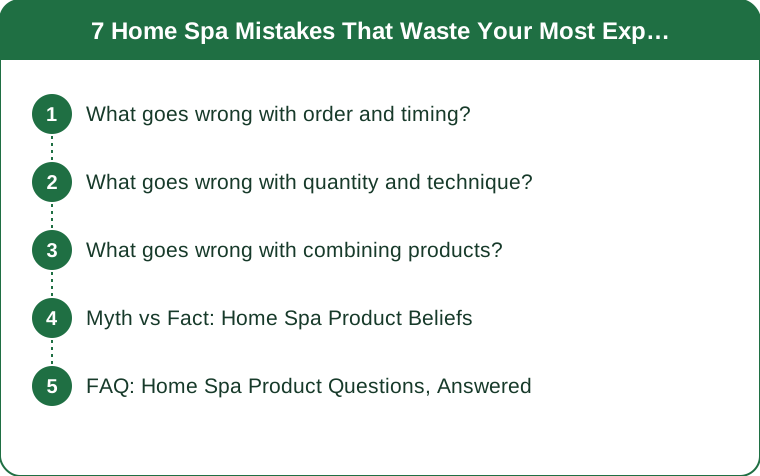
What goes wrong with order and timing?
1. Applying products in the wrong order
The rule is thinnest to thickest, and it exists for a physical reason: a thick occlusive layer forms a barrier that a thin watery product cannot pass through. Put your rich cream on first and the serum that follows is sitting on top of a wall.
The working order for a home spa evening: cleanse, tone or essence, thin water-based serum, thicker serum or treatment, eye product, moisturiser, then oil or balm last. Anything oil-based goes at the end, always - oils penetrate other products, other products do not penetrate oils.
The most expensive item in your routine is usually a serum, and serums are almost always the thing people apply too late.
2. Not waiting between layers
Most actives need a minute or two of contact time before the next layer goes on. Applying moisturiser onto a still-wet serum dilutes it and drags it around rather than letting it absorb.
Sixty to ninety seconds is enough. That is the entire fix, and it converts a rushed four-product routine into one where each product actually does its job. If waiting feels tedious, do it while brushing your teeth - the time exists, it just needs a place to go.
3. Applying to skin that is bone dry
Most water-based serums absorb better into slightly damp skin, because the residual moisture helps carry the active in and slows evaporation. Bone-dry skin, especially in the drier air of early autumn, absorbs less and leaves more product sitting on the surface.
The exception matters though: strong actives - retinoids, and to a lesser extent acids - should go on completely dry skin, because damp skin increases penetration and therefore increases irritation. Damp for hydrators and gentle serums, dry for the strong stuff.
What goes wrong with quantity and technique?
4. Using far too much
More product does not mean more effect - skin can only absorb so much, and the excess sits on the surface, pills under the next layer, or transfers onto your pillow.
Realistic amounts: a pea-sized quantity of serum for the whole face, roughly the same again for moisturiser, and a grain of rice for eye product. A retinoid needs less than most people use by a wide margin, and overuse is the single most common cause of the irritation that makes people abandon it.
This is also where the money goes. A serum used at three times the necessary amount lasts a third as long and works no better.
5. Rubbing instead of pressing
Dragging product across the face pulls at the skin and spreads unevenly. Pressing it in with flat fingers distributes it better and is gentler, particularly around the eyes where the skin is thinnest.
The practical version: dot the product in four or five places, then press and gently pat outward. Ten seconds longer, noticeably better distribution.
6. Skipping the neck and stopping at the jaw
Not really about waste, but about the result. The neck and chest show age readily and receive almost no attention. Whatever is left on your fingers after the face goes down the neck - it costs nothing and it is the single easiest upgrade to a home routine.

What goes wrong with combining products?
7. Stacking actives that fight each other
This is where genuinely expensive products get wasted, because two effective things used together can be less effective than either alone.
Combinations to separate:
- Retinoids and strong acids (AHA/BHA) in the same session. Both increase cell turnover, and together they mostly increase irritation. Alternate nights.
- Vitamin C and retinoids. Not dangerous, but they prefer different pH environments and there is little to gain from same-session use. Vitamin C in the morning, retinoid at night is the standard solution and it works.
- Multiple exfoliants. A cleanser with acids, a toner with acids, and an exfoliating serum in one evening is a barrier-damage recipe. Choose one.
- Benzoyl peroxide and retinoids simultaneously. Benzoyl peroxide can degrade some retinoid formulations. Different times of day.
What combines well: hydrating ingredients with almost anything, niacinamide with most things, and any single active with a plain moisturiser.
The broader principle worth holding onto: a home spa night is not the time to use everything you own. The instinct to make the evening feel luxurious by using six products is exactly what produces an irritated barrier and a wasted serum. Two or three well-chosen products, applied properly with time between them, outperform the full shelf every time - and cost less.
Myth vs Fact: Home Spa Product Beliefs
Myth: If it does not tingle, it is not working. Fact: Tingling is irritation, not efficacy. Some effective actives tingle mildly; plenty of the most effective ones do nothing perceptible at all. Treating sensation as feedback leads directly to over-exfoliation.
Myth: A hot steamy bathroom helps products absorb. Fact: Heat and steam increase blood flow and soften the surface, which sounds helpful, but they also increase irritation from actives and cause more product to be wiped away in condensation. Apply the serious products in a normal-temperature room, after the steam has cleared.
Myth: You should feel the product on your skin afterward. Fact: A residual film means the product is sitting on the surface, which usually means you used too much. Well-applied skincare mostly disappears.
Myth: Expensive means more concentrated. Fact: Sometimes, often not. Concentration is listed for many actives, and comparing that number is more informative than comparing prices. A well-formulated inexpensive niacinamide is not meaningfully different from an expensive one.
Myth: You need to feel your face is clean and tight after cleansing. Fact: Tightness means the barrier has been stripped, and stripped skin is more reactive to everything you apply next. This one mistake ruins more expensive products than any other, because it changes how the whole routine behaves.
FAQ: Home Spa Product Questions, Answered
How long before I can judge whether a product works?
Hydration effects show within days. Texture and tone changes from actives take 8 to 12 weeks, because that is how long skin turnover and collagen response require. Judging a serum after two weeks is the most common reason good products get abandoned.
Does putting products in the fridge help?
It makes them feel pleasant and can reduce puffiness through the cold itself. For most formulations it neither helps nor harms stability. Vitamin C is the exception worth refrigerating, since it oxidises with heat and light.
Should I use a sheet mask before or after serum?
After cleansing and before your serum, as the mask essence is mostly hydration. Then seal with moisturiser. Using a mask at the end of a full routine mostly wastes both.
Is a home spa night bad for my skin if I do it weekly?
It depends entirely on what the night involves. A weekly hydrating mask and a proper moisturiser is fine indefinitely. A weekly multi-step exfoliation is too much for most skin. If your skin is stinging, flaking, or reacting to products it used to tolerate, the routine is the cause. Persistent irritation is worth a dermatologist’s opinion. This is general information, not medical advice.
TL;DR:
- Order matters physically: thin to thick, oils last. A serum applied after moisturiser is largely wasted.
- Wait 60 to 90 seconds between layers, apply hydrators to damp skin and strong actives to dry skin.
- Use less than you think - a pea for serum, a grain of rice around the eyes. Excess pills and transfers.
- Do not stack retinoids with acids, or multiple exfoliants, in one session. Alternate nights instead.
- Tightness after cleansing is barrier damage, and it undermines everything applied afterward.
Before buying a replacement, run the current product properly for eight weeks. Most of the time that is the whole fix.
Keep Reading
This article is for general informational and styling purposes only. Fit, sizing, and product availability may vary.