7 Home Spa Habits That Quietly Wreck Sensitive Skin
Quick Answer: Most home spa irritation comes from doing too many actives in one session, using water that is too hot, and over-exfoliating — all of which strip the skin barrier faster than it can rebuild. Sensitive skin does better with a shorter routine, lukewarm water, one active ingredient at a time, and a longer gap between treatments. If your skin looks worse the morning after a spa night, the routine is the cause, not the reason you needed one.
You set aside two hours, lit a candle, and used every product you own.
The next morning your face is red, tight and stinging when you apply moisturiser.
Here are the seven habits behind that — and number three is the one almost everybody defends.

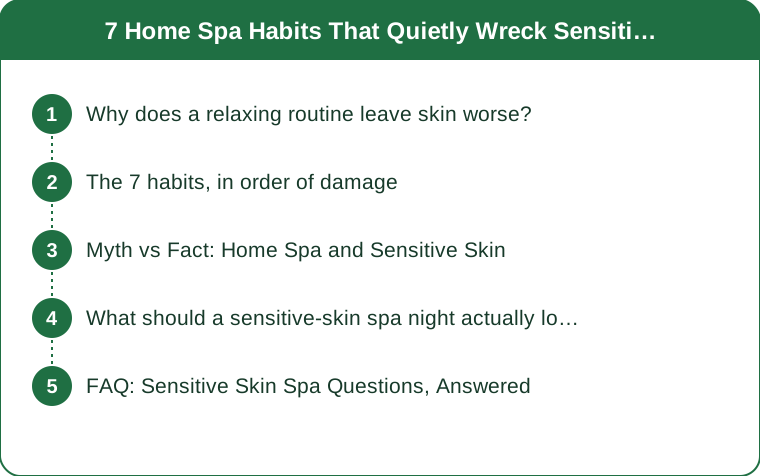
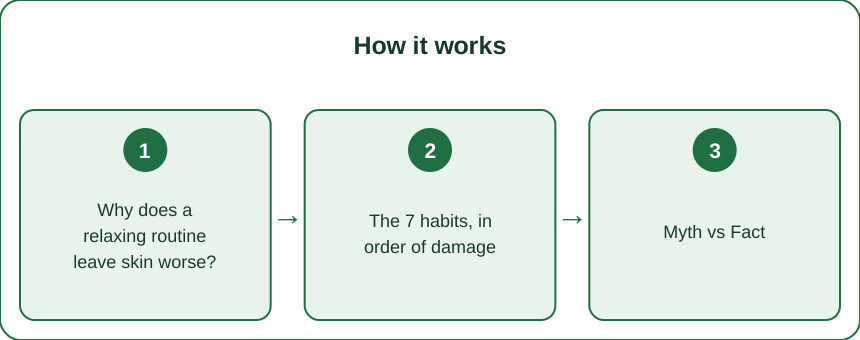
Why does a relaxing routine leave skin worse?
Because the skin barrier is a physical structure, and most spa-night rituals attack it from several directions at once.
The barrier is a layer of lipids holding everything together. When it is intact, it keeps water in and irritants out. When it is compromised, water evaporates faster, ingredients penetrate more deeply than intended, and everything you apply stings.
Damage accumulates faster than repair. Barrier recovery takes days, not hours. A single aggressive session on Friday is still being repaired on Monday, and doing it again the following weekend means the barrier never fully returns.
Sensitive skin has less margin. A thinner or more reactive barrier means the same treatment that a resilient skin type tolerates produces visible irritation. This is not a matter of using better products — it is a matter of dose.
The relaxation framing hides the problem. Because the session feels indulgent and caring, it does not occur to most people that it is the source of the damage. The tight, squeaky feeling gets interpreted as clean rather than as a signal.
Real spas do less than home routines do. A professional facial typically involves one exfoliation method, one treatment step and heavy emphasis on soothing afterward. Home routines routinely stack four or five active steps in ninety minutes.
The 7 habits, in order of damage
1. Stacking multiple actives in one session
A chemical exfoliant, then a clay mask, then a vitamin C serum, then a retinoid. Each is fine alone. Together they compound, and the last one lands on skin whose barrier has already been thinned by the first three. Use one active per session and let the others wait for another night.
2. Water that is too hot
Hot water feels like the whole point of a spa night, and it strips lipids from the skin surface efficiently. It also causes flushing that lingers, which is particularly problematic for anyone prone to redness. Lukewarm water for cleansing and rinsing, and a shorter, cooler bath than instinct suggests.
3. Exfoliating too often, or twice in one session
The habit people defend hardest. Physical scrub followed by a chemical exfoliant is a genuinely common home routine and it is roughly double the intended dose. For sensitive skin, one exfoliation method, once or twice a week at most, and never on the same night as a strong active. If your skin is currently irritated, the answer is zero, not gentler.
4. Steaming for too long
Steaming feels productive and does help soften surface debris, but extended steaming increases transepidermal water loss and can worsen redness and broken capillaries. A few minutes is plenty, and anyone with rosacea or persistent flushing is usually better skipping it entirely.
5. Leaving masks on until they dry hard
The instruction on most clay masks is to remove them while still slightly tacky, and almost nobody does. A fully dried clay mask pulls moisture back out of the skin as it dries, undoing the point of the treatment. Set a timer, and remove it before it cracks.
6. Skipping the soothing step because it feels like an anticlimax
After the treatment is when the actual repair happens. A simple, fragrance-free moisturiser with barrier ingredients — ceramides, glycerin, squalane — applied to slightly damp skin does more for the next morning’s appearance than any of the preceding steps. It is the least exciting part of the routine and the one that determines the result.
7. Introducing several new products at once
A spa night is a common occasion to try three things that arrived this week. If your skin reacts, you have no idea which one caused it, and you will likely abandon all three. Introduce one new product at a time with several days between, and patch test on the inner forearm or behind the ear first.

Myth vs Fact: Home Spa and Sensitive Skin
Myth: Tight, squeaky skin means it is properly clean. Fact: That sensation is the barrier having been stripped. Properly cleansed skin feels comfortable and slightly soft, not tight.
Myth: Natural and DIY ingredients are gentler. Fact: Lemon juice, baking soda, undiluted essential oils and raw apple cider vinegar are among the most common causes of home-routine irritation. Being natural says nothing about pH or irritancy.
Myth: A little stinging means it is working. Fact: Stinging on application usually means the barrier is compromised. Products that sting on damaged skin do not sting on healthy skin, which is the tell.
Myth: More steps means better results. Fact: For sensitive skin the relationship inverts past a small number of steps. A three-step routine done consistently beats a ten-step routine done weekly and recovered from all week.
Myth: Purging explains any breakout after a spa night. Fact: Purging applies to specific ingredients that accelerate cell turnover, appears in areas you normally break out, and resolves within a few weeks. Irritation from an aggressive routine appears anywhere, comes with redness or stinging, and is not something to push through.
What should a sensitive-skin spa night actually look like?
Shorter, simpler, and built around one treatment rather than a sequence of them.
Cleanse gently with lukewarm water. A cream or oil cleanser, no scrubbing, no washcloth friction.
Pick one treatment step. A hydrating mask, or a gentle exfoliant, or a soothing sheet mask. One, not three, and rotate which one across weeks rather than stacking them in a night.
Follow immediately with a barrier moisturiser on damp skin. This traps water and gives the barrier the lipids to rebuild with.
Keep the bath lukewarm and shorter than you think. Twenty minutes in comfortably warm water rather than forty in hot. Moisturise the body within a few minutes of getting out, while skin is still slightly damp.
Do the relaxing parts that are not skin treatments. Candles, music, a warm drink, a proper wind-down, a hair mask that does not touch your face. Most of what makes a spa night feel restorative has nothing to do with how many actives you applied.
Leave a gap of at least a few days before the next active treatment. Barrier repair is measured in days. A weekly rhythm suits most sensitive skin; twice weekly is the ceiling.
Adjust for the season now. As humidity drops through late summer into autumn, skin loses water to the air faster, and a routine that was tolerable in August frequently becomes irritating in October. Reduce exfoliation frequency and increase moisturiser richness before the problem appears rather than after.
If you have persistent redness, burning, or a reaction that does not settle within a few days, see a dermatologist. This is general information, not medical advice.
FAQ: Sensitive Skin Spa Questions, Answered
How do I know if my barrier is damaged?
Tightness after cleansing, stinging from products that used to be fine, unusual dryness or flaking, and increased redness. It usually settles within one to two weeks of stripping the routine right back.
What should I do while it recovers?
Gentle cleanser, plain barrier moisturiser, sunscreen. Nothing else. No actives, no exfoliation, no new products. It is boring and it works.
Can I ever exfoliate again?
Yes, once the skin is comfortable. Reintroduce one method at low frequency — once a week — and hold there for a month before considering more.
Are sheet masks safe for sensitive skin?
Generally yes if they are fragrance-free and hydrating rather than active. Avoid anything with high alcohol, strong fragrance or exfoliating acids if you are already reactive.
Is fragrance really a problem?
For sensitive skin, it is one of the most common triggers — both synthetic fragrance and essential oils. Fragrance-free is a genuinely useful filter when shopping.
Should I still use sunscreen after a spa night?
Yes, and more carefully than usual. Skin that has been exfoliated or treated is more sun-sensitive for several days, and that is when pigmentation problems start.
Does drinking water help my skin?
Adequate hydration matters for overall health, but the barrier is repaired by lipids applied topically, not by extra glasses of water. Do both, but do not expect the water to do the barrier’s job.
TL;DR:
- Barrier damage comes from stacking actives, hot water and double exfoliation in one session.
- Tight, squeaky skin is a warning sign, not a sign of cleanliness.
- Use one treatment step per night, then a barrier moisturiser on damp skin.
- Remove clay masks before they dry hard — a dried mask pulls water back out.
- Barrier repair takes days. Leave a real gap between active sessions, and reduce frequency as autumn air dries out.
A shorter routine done weekly beats an elaborate one you spend the rest of the week recovering from.
Keep Reading
This article is for general informational and styling purposes only. Fit, sizing, and product availability may vary.